
November is National Family Caregivers Month, a time to recognize the millions of people quietly holding their families together. If you’re one of them, you may not have noticed the occasion. You’ve just been too busy.
The holidays are coming, work is in its year-end push, and the school concerts keep landing on your calendar. In between, you’re calling Mom to ask whether she took her evening pills and moving a meeting so you can drive Dad to the cardiologist. On the way home, you wonder whether Mom remembered to turn off the stove after making dinner.
If that sounds familiar, you’re carrying what so many caregivers carry: the Second Shift. It is the unpaid, unscheduled job that starts after your real job ends, and sometimes right in the middle of it.
You Are Far From Alone
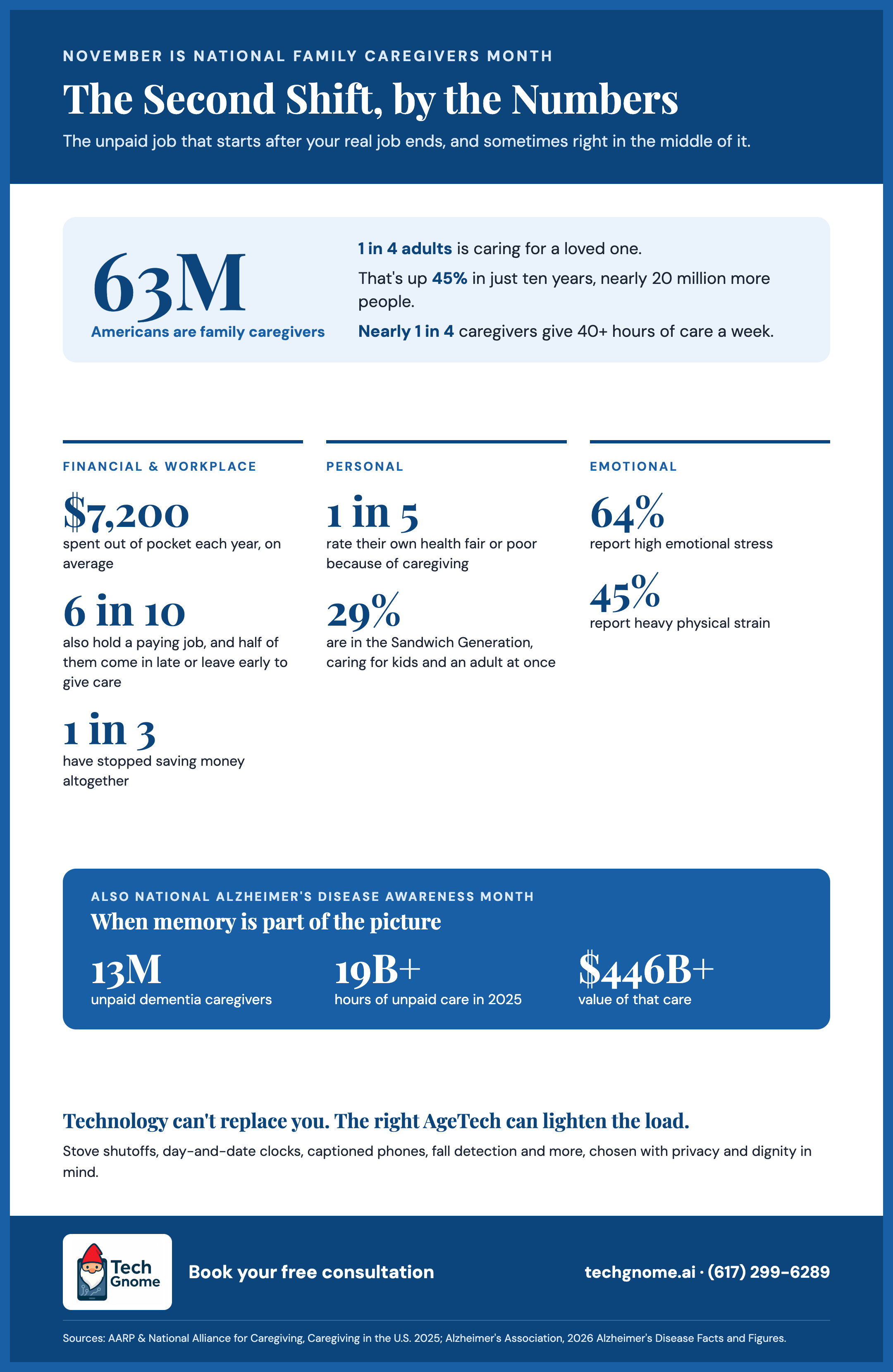
According to AARP and the National Alliance for Caregiving, 63 million Americans, about 1 in 4 adults, are now family caregivers. That is a 45% jump in just ten years, nearly 20 million more people. And nearly 1 in 4 of those caregivers provide 40 or more hours of care every week, which is a full-time job on top of everything else.
National Family Caregivers Month honors caregivers for all the sacrifices and hard work
The Financial and Workplace Toll
Six in 10 family caregivers also hold a paying job, and half of them report work disruptions like coming in late or leaving early to care for a loved one. You know the drill: "I'll make up the hours tonight."
The money adds up too. Caregivers spend an average of about $7,200 a year out of their own pockets. Nearly half report at least one major financial hit, and one in three have stopped saving altogether.
The Personal Toll
A caregiver’s own health is often the first thing to be neglected. Rest, checkups and self-care slip down the list, and exhaustion becomes the norm. For the first time, the AARP report measured caregivers' own health, and nearly 1 in 5 rated it fair or poor because of caregiving. If you're part of the Sandwich Generation, caring for kids and a parent at once, the squeeze is even tighter.
The Emotional Toll
This is the part that rarely shows up on a calendar. Nearly two-thirds of caregivers (64%) report high emotional stress. It’s due to the mental load: the constant tracking of medications, appointments and what-ifs that never really switches off.
When Memory Is Part of the Picture
November is also National Alzheimer's Disease Awareness Month. More than 7 million Americans are living with Alzheimer's, and the Alzheimer's Association reports that nearly 13 million family members and friends provided more than 19 billion hours of unpaid care in 2025, valued at more than $446 billion. Dementia caregiving often means the same questions every hour and a worry that never really clocks out.
Where Practical AgeTech Can Lighten the Load
Technology can't replace you. But the right AgeTech, chosen with privacy and dignity in mind, can take some of the checking-in off your plate so your parent stays safe and independent at home:
Fire and kitchen safety: stove shutoff devices, connected smoke and CO alarms
Memory and cognition: day-and-date clocks, door sensors, GPS locators, tamperproof electrical outlet covers
Vision changes: voice assistants, larger text and magnifier settings, automatic lighting
Hearing changes: flashing and vibrating alerts, captioned text, bluetooth hearing aids
Dexterity and mobility changes: fall detection, voice controlled systems, motion-activated night lights
Safe home environment: Smart thermostats, video doorbells, smart water leak sensors
The Bottom Line
You don't need to add one more research project to your November. A TechGnome expert can handle the heavy lift, from figuring out what fits your parent's needs to installing it and making sure everyone is comfortable using it. The goal is simple: a little more peace of mind for you, and a little more independence for the person you love.
This month, give yourself some credit, and maybe some help.
